We can't build anything anymore.
And it's not for lack of trying. We just can't seem to agree on anything long enough to execute it cleanly.
Cities double in population over thirty years and we still sincerely argue about whether the transit line needs expanding. Ugh, more houses? What's next — bike lanes?
Taxes are through the moon, yet the infrastructure withers and the traffic still gets worse. Nobody's happy, and nobody seems to have a plan to get out of it.
This appears to be the baseline condition of humanity. We can conceptualize that long-term thinking exists — in the abstract, somewhere, maybe over in Europe — but we can't resist the temptation of short-term squabbling.
So we've been in office a long time now, and we really haven't had the best tenure. Nobody's perfect, alright. But there's a hot new sheriff in town with decision-making capability. Some places are even starting to hand real administrative work to AI on the grounds that the human condition is invariably corruptible — Albania has gone as far as appointing an AI "minister" to clean up graft in public contracts.
Which begs an interesting question. Are we doomed to simply accept the "correct way forward" from an artificial intelligence? Or is there genuine strength in human decision-making?
Let's stress test it with an extreme framing.
The Fantasy Scenario
James Cameron's 1984 and 1991 films — Terminator 1 and 2 — are more analytically useful than they have any right to be.
Cameron isn't a computer scientist, and the films aren't an exact technical mapping for the Claudes and GPTs we did end up navigating in the future. Jury's still out on the Google-to-Skynet link.
But as a genuine thought experiment — humans vs artificial general intelligence in an all-out extinction scenario — the analysis gets prescient and interesting fast. Cameron, through pure disciplined storytelling, seemingly mapped the competitive advantages of both sides with remarkable accuracy.
The Machines — And Why We're Probably Cooked
In the first film, Skynet (our AI antagonist) needs to eliminate Sarah Connor — future mother of John Connor, leader of the human resistance. By eliminating John in the past, it removes the biggest obstacle to its world domination in the present (the 2020s, gulp).
It sends a T800 Terminator back to 1984 to murder Sarah. The machine, true to form, starts tapping the data sources of the time. The phone book shows multiple Sarah Connors in the city. It doesn't have enough context to know which is the target — just rough details, approximate city, approximate year.
So the T800 starts working through the phone book programmatically. Alphabetical order. Every Sarah Connor in the city, eliminated. By pure luck, our target Sarah happens to be near the end of the list, and the news of the "phone-book killer" tips her off.
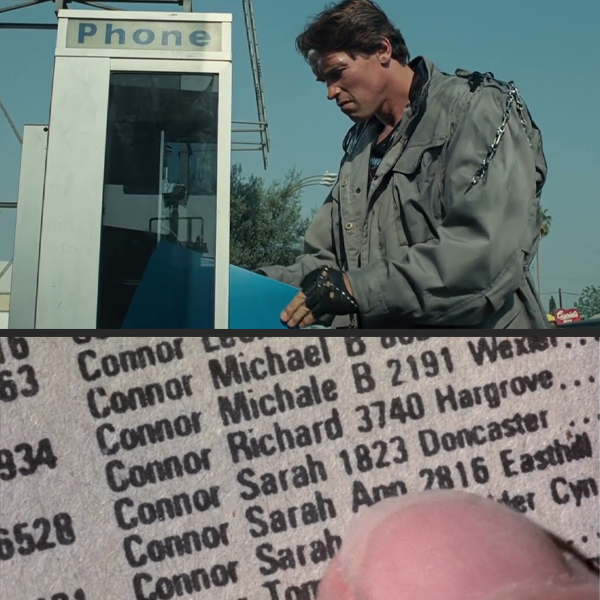
This is machine logic in its purest form. No emotional friction, no moral hesitation, no cognitive bias. Just a probability tree, a list, and ruthless execution toward the objective.
Frankly, from our chimp-like perspective, Skynet already has a few things stacked in its favour that play well together:
- It never sleeps, never panics, never has ego conflicts with other units
- Perfect coordination across its entire network — no communication breakdown, no chain-of-command politics
- Learns and adapts at machine speed across millions of scenarios simultaneously
- Exploits human instinct as a weapon
- Easily weaponizes the bureaucracy and predictability of human institutions
In T1, the T800 murders Sarah's mother and assumes her voice — correctly calculating that a woman on the run will eventually crack and call home. It's not brute force. It's precise psychological modelling, weaponized.
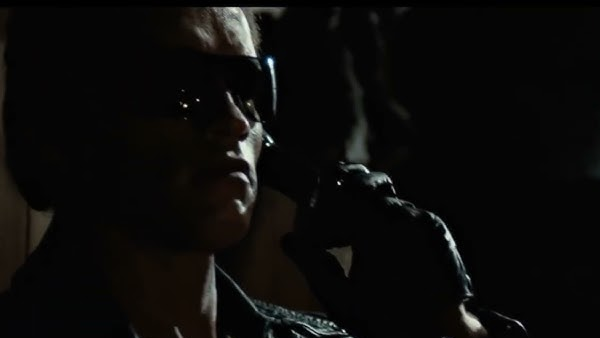
In T2, the T1000 — the liquid-metal, more advanced successor — takes this further. Within minutes of arriving in 1995, it's taken the form of a police officer, tapped into law enforcement databases, secured a vehicle, and is already on its way. The institutions of 1990s America, designed to protect people, become weapons against humanity immediately.
And here's the cruel twist: our heroes don't just have a liquid-metal killing machine to contend with. They have every cop in the city hunting them too.
In T2, the T800 becomes the protagonist — a different unit, reprogrammed to serve as a protector for John and for humanity's interests. But sharing the physical characteristics of the first machine makes it pay for its sins. Killing almost 22 people in the first film and massacring a whole police station made the T800 quite popular.
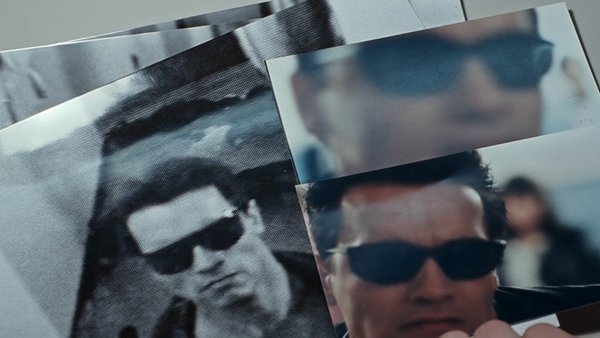
Day one of this machine stepping into 1995, it's suddenly on the radar of the police, with immense pressure and firepower aimed its way. Meanwhile — who's able to operate alongside the police, collect intel, subtly orchestrate them, and strike at the most vulnerable moment? Oh, right.
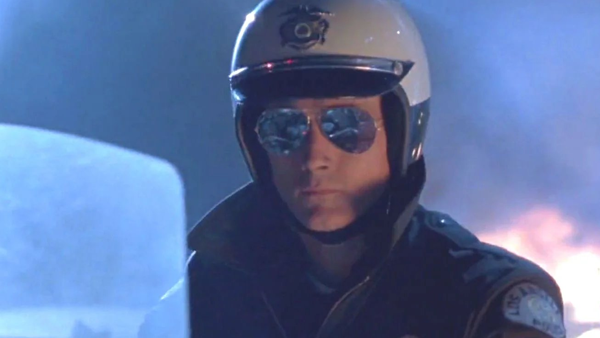
Practically speaking, if we found ourselves in this specific existential battle with an AI, we'd be forgiven for putting our money on Skynet.
One striking scene in the "future" segments of Terminator 1: a single Terminator infiltrates a basecamp and wipes out a whole community on its own.
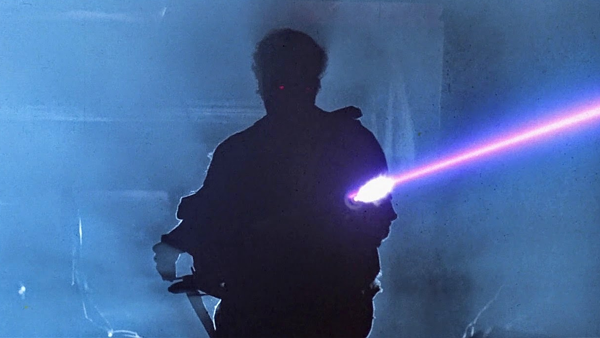
The math of replacing those humans for the war's counter-effort is genuinely incalculable — finding each other, surviving long enough, raising children in a nuclear wasteland, training them. Hoping they don't die in the next raid. Getting them through that punk teenager phase where "Skynet's making some good points, Dad." Meanwhile Skynet just copy-pastes more machines that are lethal from day one.
We're bags of meat. Fragile, emotional, easily divided. We can scarcely resist Facebook propaganda, let alone a hivemind operating with uncanny-valley uniformity and zero internal politics.
Machine Versus Machine — The Chess Match
What I find particularly fascinating in T2 is something Cameron barely underlines — two artificial intelligences having a logic battle for most of the film.
When the T1000 arrives, the T800 is already in play protecting John. Neither can afford reckless direct engagement — confrontations are expensive, tactically risky, uncertain in outcome. After their initial action-packed encounters, the battle cools and the parties separate.
Both machines are now running probability trees in real time, trying to out-anticipate the other.
The T1000's initial logic map on John Connor is genuinely elegant:
- Go to his house
- Survey his foster parents
- Eliminate and imitate
It nearly works. John, simply being a human being, says: "Hey, I need to go to my house to get some stuff."
"Negative," the T800 shoots back. "The T1000 will almost certainly try to re-acquire you there."
"You sure?" John replies. "I would," shrugs the Terminator.
John knows his foster parents "are dicks," but "I have to warn them." It's one of the most memorable beats in the film.
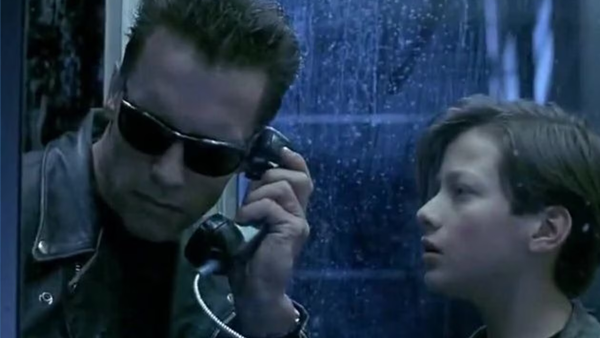
"Something's wrong — she's never this nice," John whispers, confused. The T800 takes over and mimics John's voice.
"Hey Janelle, how's Wolfie? I can hear him barking" — and the trap collapses. The T1000, realizing the jig is up, immediately recalculates. Sarah Connor is a primary target with dangerous tactical knowledge. John will likely make contact. Therefore: copy Sarah Connor, position at the hospital, and wait.
This is game theory playing out in an action film. Not chasing the target — modelling where the target will go, and being there first.
The T800 even flags it explicitly when Sarah breaks away to act alone: "this is tactically dangerous, the T1000 might anticipate this move." Sure enough, unprompted, it shows up at the Dyson house later. Not because it followed them — because it reasoned its way there. It knew Sarah Connor well enough (her documented obsession, her psych profile, her history of trying to blow up a computer factory) to predict her next move from pure probabilistic logic. Of course she's going to try to take out Skynet's chief engineer.
Six Rules the Machines Actually Follow
Watch them long enough and the Terminators are clearly running off a handful of simple rules. Cameron never spells them out — they just hold, because he never cheats the logic. Here's what they actually are.
- It optimizes for the kill, not the carnage. After the crash in T1, surrounded and outgunned, the Terminator just leaves. Not scared — it probably could have come out the victor — it's bad odds. Why force a fight you might lose when you can come back and win clean?
- No information? Brute force it. It doesn't know which Sarah Connor, so it does all of them, alphabetically. Cold as ice.
- Don't fight the system — become it. The T1000 is a cop within minutes. Database, car, authority, the lot. The infiltrator walks into the camp as a human. Why kick the door in when you can hold the keys?
- Let your enemy build your trap. By T2 the cops and the doctors already think Sarah's a dangerous lunatic — and she did it to herself in between the two films. Never interrupt your enemy (or target) while they're making a mistake.
- Travel alone, travel dark. I wondered if there was active communication between Skynet from the future. But it makes sense to have them as fully contained units back in time — if humanity captures one, they get the master key. (Though the dead one they leave behind is exactly how Skynet ends up getting built. Whoops.)
- It only wins when you're predictable. Every clean kill it gets is because a human did the human thing. Called home. Went where they always go. The machine is only ever one step ahead of a person running on autopilot.
The Humans — Where It Gets Interesting
So, given all of the above: what do humans actually bring to this fight?
Here's where Cameron does something brilliant. Every genuine human advantage in the Terminator series is rooted in what a pure logic system would classify as a flaw.
Kyle Reese, the resistance fighter sent back to protect Sarah in the first film, is the only human in T1 who correctly understands the threat. He grew up fighting these machines under John Connor in the future. His behaviour looks genuinely insane to everyone in 1984.
His entire playbook is built on a single piece of knowledge earned through years of trauma: you can't fight a killer machine head-on. So he stays low. Cuts angles. Denies it the clean engagement, creates distance, buys seconds. He only takes the machine on directly at the very end, when there's no other option — a kamikaze move that costs him his life and saves Sarah's.
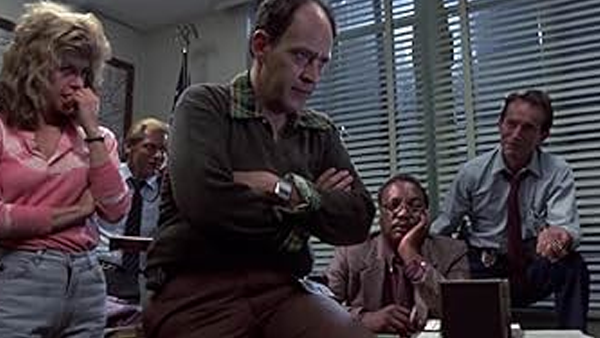
In the police station massacre, trained officers put clean, accurate rounds into the T800 — center of mass — only for it to absorb them, shrug, return fire, and kill them anyway. Reese crawls past them and gets Sarah out. The natural human impulse to help the people dying around him gets suppressed entirely in service of the mission.
Reese isn't acting like a machine. But he's learned to evolve past the modelling capabilities of the Terminators, which makes him a genuinely difficult, unpredictable foe — which is exactly why he can slip past a room full of cops who are, by all accounts, better shooters with contemporary weapons. He isn't idly trading shots with the Terminator. He's solving a different problem than everyone else in the building.
And then there's Miles Dyson, the chief architect of Skynet.
Dyson is, by all accounts, a decent man. Intelligent, great career, lovely home, young family, on the verge of the most significant professional breakthrough of his life. He's reaching for something he can't quite see yet, but he's close.
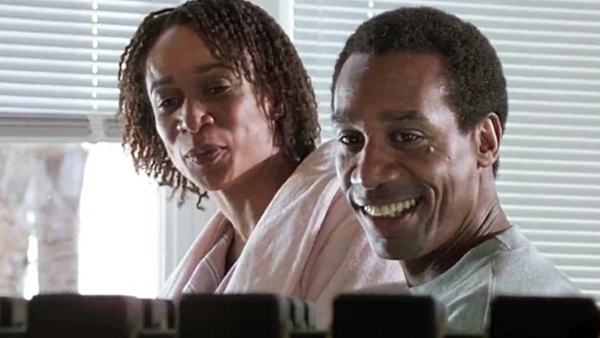
From Skynet's perspective, the interest lies in the continuity of his research — not necessarily him as a person, but the trajectory his work represents. Skynet doesn't exist yet in the 90s, but it can't exist at all if Dyson doesn't finish the project.
Then, of course, two strangers and a robot break into his house. Shoot him in the shoulder in a botched assassination attempt. And tell him he'll be responsible for three billion deaths.
"He took it pretty well," as Sarah suggested.
Dyson immediately pivots. He asks what he can do for the mission — going as far as helping these strangers break into his own office to destroy the research. His life's work, straight down the drain.
In the climax, Dyson holds a detonator while bleeding out from police fire, waiting for the right moment to bring the whole thing down.
From Skynet's probability model, the idea that the chief architect of the technology would flip into an antagonist is a catastrophic failure. The sunk-cost fallacy says Dyson should protect his research. Self-preservation says Dyson should survive. Every logical model produces the wrong prediction.
Because Dyson made a moral choice under duress. The choice to take direct action against Skynet was his.
It's even possible the T1000 might have jumped to his "rescue" from his would-be assassins — seeing his tactical merit, provided he stayed aligned with Skynet. We do know the T1000 surmises Dyson's house is a place of interest, ending up there toward the end of the film on its own discovery, only to find the research already gone.
Yes, it's Hollywood. But the fact that it's Hollywood — and that it resonates so powerfully with us as Hollywood — is exactly what underscores the human scaffolding holding it up.
All Strengths Cast a Shadow
Here's what I think Cameron actually understood, whether explicitly or intuitively.
The human strength here is the shadow side of a human weakness.
The behavioural economist Daniel Kahneman spent a career — earning a Nobel Prize for it — proving that humans are systematically irrational. Susceptible to bias, heuristics and cognitive shortcuts that cloud judgment and produce objectively poor decisions.
Most people read that body of work as a problem to solve. A bug to be patched, or sanded down through awareness.
The Terminator films suggest it might be our most competitive asset in the one context that counts: what makes humans genuinely hard to beat against an AI.
Our chaos, our tribalism, our spectacular inability to agree on that subway expansion — these are the same qualities that make us fundamentally un-modellable at the edges.
A species that can't reach internal consensus can't be predicted from consensus assumptions. Simply put.
A species that can regularly act against its own survival interest for abstract reasons — love, principle, conscience, even guilt — is a species that will always produce outcomes outside any reasonable probability space.
The T1000 never anticipated the Dyson flip. Because Dyson did something that clean logic — and even Kahneman's own loss-aversion work — said he wouldn't do. Yes, "sunk-cost fallacy" is a logical fallacy. It's also unbelievably powerful. Who willingly torches their life's work on a dime? Someone with a moral principle that holds humanity in higher regard than themselves.
Our frustrating, maddening, irrational humanity isn't a bug to optimize away. It's the one thing the machine genuinely cannot counter. Every strength casts a shade. But here, the shade is the strength — the only thing that can offer a real tactical affront to an intense modelling machine is being chaotic and unpredictable.
Unfortunately, that comes from the same place the NIMBY subway argument comes from. From living in a pluralistic society where you might not agree with your neighbour's religious beliefs, but the taxes still get paid and the trash still gets picked up. From being messy and contradictory and occasionally willing to throw your life's work into the blender because you realized — oh god — you were actually working for the baddies.
The Actual Point
Fortunately, we're not facing Judgment Day. We're watching humans augment their workflows with AI, and in some cases outright replace them — the gradual integration of that "other sheriff in town." Whatever else we take from this, it's clear there's an alternative synthetic intelligence at the table now. We're not organic-only anymore.
The anxiety about jobs is real, and I won't dismiss it. These models are impressive, and getting more so by the millisecond. They're powerful enough that the question of control is no longer academic — the US government recently forced one major lab to pull its most capable models offline over a disputed security finding, the first time that's happened to a publicly deployed system. Some things humans currently do will be done better by machines, and that's a genuine disruption for real people.
But here's what the machine cannot do.

It can't care that your parents are getting older. It can't get that quiet feeling that something just isn't adding up — that the talk isn't matching the walk. It can't be proud of your kid's first graduation, or hear their first words and feel anything at all. It can't enjoy a coffee on the porch, or drink a little too much when your college friends are back in town. It can't make the boldest, most improbable, most right financial move of your lifetime on instinct alone. It'll never understand why you keep an aging record collection that not another soul on earth cares about.
It cannot make the Dyson choice. It cannot hold the detonator. It cannot crawl through a burning building on pure irrational love and come out the other side changed by it. It cannot produce the outcome that lives outside the probability space — because by definition, it can only ever work inside one.
Philosopher and neuroscientist Sam Harris put it plainly: what the world is going to need are well-educated generalists with good taste — people who've read good books, gone to good museums, had good arguments and can make good ones. He called it the revenge of the humanities. The idea that in a world where machines handle the execution, the competitive advantage moves entirely upstream — to judgment, to taste, and to the specifically human ability to know what's worth building in the first place.
The vibe-coding meme rings true here too: "I've shipped 23 apps and I have 0 customers." AI can help you build. It can't help you plug the hole in your soul you're trying to vibe-code over.
The most dangerous thing we could do right now — professionally, culturally, as a species — is look at the machine's clean logic and efficiency and decide that's where we need to double down. To smooth away the irrationality. To optimize ourselves toward predictability.
Because predictability, as Cameron showed us forty years ago, is exactly how you get killed.
Some things look like weaknesses. But in the right context, against the right opponent — they're the whole game.
Particularly our ability to be irrational, goddammit.
Augmenting your team with AI?
The edge isn't optimizing your people toward the machine. It's knowing what's worth building in the first place — and that's a judgment call.
Let's Talk